The Baccarat Table Layout
Before a single card is dealt, the baccarat table is already telling you a story. Every printed zone, numbered rectangle, and painted line is a piece of tradecraft — a silent instruction on where your money goes, how much you could win, and what the house expects in return. Master the layout and you arrive at the felt fully briefed, not blinking into the baize like a tourist.
Two Formats, One Game
Baccarat tables come in two principal configurations, and knowing which you are sitting at shapes everything from your betting pace to how you interact with the dealer.
The Full-Size Baccarat Table
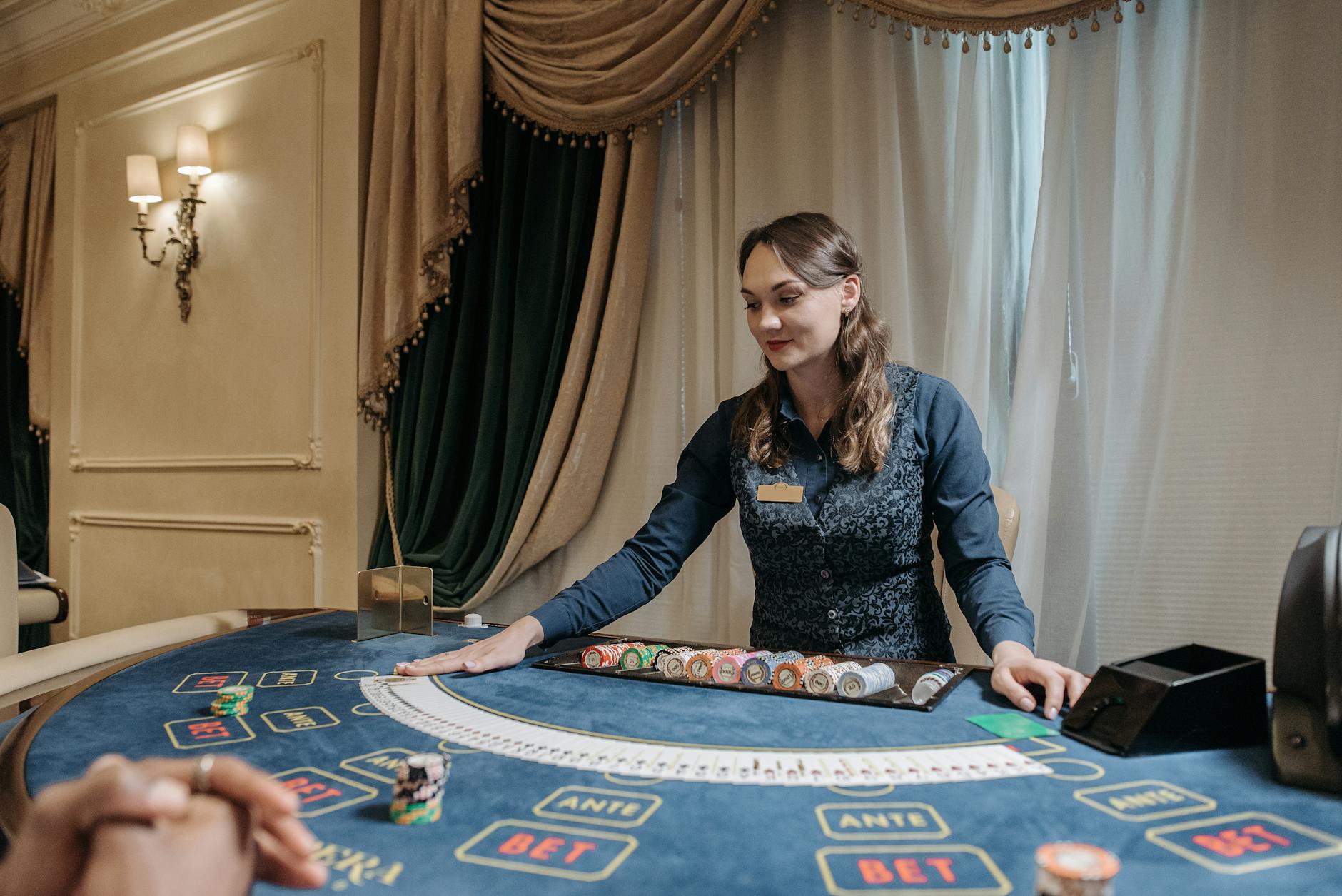
Found in dedicated baccarat pits in high-limit rooms, the full-size table is large, kidney-shaped, and typically seats up to 14 players. Three dealers manage play: two handle bets and payouts at each end, while a third — the caller — manages the cards in the centre. The layout is mirrored, meaning betting positions 1–7 are replicated on each side. You will notice position 13 is often skipped for superstitious reasons, jumping from 12 to 14.
The Mini-Baccarat Table
Far more common in standard casino floors and virtually universal in online and live-dealer environments, mini-baccarat seats up to seven players and is run by a single dealer. The layout is simplified but contains all the same essential zones. This is the version most beginners encounter first, and the one mirrored almost exactly in live dealer baccarat.
Anatomy of the Betting Layout
Strip away the felt colour and casino branding and every baccarat table resolves into the same functional zones. Here is what each one means.
Player Betting Area
Labelled simply PLAYER, this is the closest betting rectangle to the players seated at the table. A winning Player bet pays even money (1:1) and carries no commission. The house edge on a standard eight-deck game is approximately 1.24%. It is the simpler bet, but fractionally less favourable than Banker over the long run.
Banker Betting Area
Positioned in the centre of the layout, the BANKER zone is the statistically stronger wager. A winning Banker bet also pays 1:1, but the casino retains a 5% commission on winnings, which is why the net house edge sits at approximately 1.06%. That commission is what keeps the game balanced — without it, Banker would be a positive-expectation bet. You can read the full reasoning in Why the Banker Bet Pays Commission.
Tie Betting Area
The TIE box sits furthest from the player, and for good reason — treat it with caution. A Tie bet typically pays 8:1 (occasionally 9:1 at some tables), yet the house edge on the standard 8:1 payout in an eight-deck game is approximately 14.4%. That is not a misprint. The Tie bet is one of the worst wagers in the casino. Our dedicated article The Tie Bet Trap explains exactly why.
Side Bet Zones
Many modern tables, particularly in live-dealer studios, include optional side bet panels printed adjacent to the main areas. Common examples include Player Pair and Banker Pair — wagers on whether the first two cards dealt to each side will be a matching pair, typically paying 11:1. These carry significantly higher house edges than the main bets and are best understood before committing chips to them.
Commission Tracking: The Number Grid
On full-size tables, you will see a grid of numbered boxes printed in front of the dealers. These correspond to each player's seat number and are used to track commission owed on winning Banker bets. Rather than collecting commission hand-by-hand (which would slow the game considerably), the dealer tallies it in the grid and collects the total when a player leaves or when the shoe is exhausted. On mini-baccarat tables, commission is usually collected immediately after each winning Banker hand.
The Roadmap Panels
One feature that surprises newcomers is the cluster of scoreboard grids printed — or displayed on a screen — at one end of the table. These are the baccarat roadmaps: the Bead Plate, the Big Road, the Big Eye Boy, the Small Road, and the Cockroach Road. They record the history of recent hand outcomes using coloured symbols.
It is critical to understand that these boards are informational, not predictive. Each hand of baccarat is an independent event; past results carry no mathematical influence over future ones. The roadmaps are a cultural feature of the game, deeply embedded in its Macanese and Asian playing traditions. To learn how to read them properly, see our guide to Reading the Roadmaps: Bead Plate to Big Road. You can also track patterns interactively using the Shoe Pattern Board.
Key Table Markings at a Glance
| Zone / Marking | Purpose | Payout | House Edge (8 decks) |
|---|---|---|---|
| Player | Main bet on Player hand winning | 1:1 | ~1.24% |
| Banker | Main bet on Banker hand winning | 1:1 (less 5% commission) | ~1.06% |
| Tie | Bet that both hands tie | 8:1 (standard) | ~14.4% |
| Player Pair / Banker Pair | Side bet on a matching first two cards | 11:1 (typical) | Varies; typically 10–11% |
| Commission Grid | Dealer tracking of Banker commissions owed | N/A | N/A |
| Roadmap Panels | Historical outcome display | N/A | N/A |
Putting It Together: Your Pre-Game Briefing
Understanding the table layout is the first step in approaching baccarat with genuine confidence. Once you can identify every zone at a glance, you can focus on the decisions that actually matter: which bet to place, how much to wager, and when to walk away. For a full primer on how the game actually unfolds, see How to Play Baccarat: Step by Step. When you are ready to think about staking, the Q Branch staking calculator can help you model sensible bet sizes relative to your session bankroll.
Responsible gambling note: Baccarat is a game of chance. No knowledge of the table layout, roadmap patterns, or betting systems can alter the house edge or guarantee a profit. Set a firm session budget before you sit down, and treat any time at the table as entertainment, not income. If gambling stops feeling like fun, visit BeGambleAware for free, confidential support.
Play Responsibly · 18+
Baccarat is a game of chance with a fixed house edge. Set limits before you play and never chase losses. Support: BeGambleAware · Our RG hub.
▸ Related Briefings